The Traveling Ashlar Weekly Trestleboard | Edition 0010 | Week of October 26, 2026 · A.L. 6026

Edition 0010 Week of October 26, 2026 · A.L. 6026
Updated every Monday Last updated October 26, 2026 · A.L. 6026
Masonic News From Around the World
Strange, historic, important and occasionally downright odd stories from around the Craft.
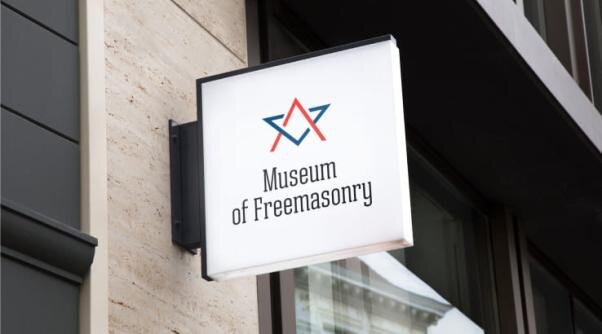
A museum opened on Baznīcas Street in Riga on Oct. 20. The sign says Museum of Freemasonry. The man who built the collection says he spent ten years buying the objects so the city could look at the Craft without a conspiracy attached.
In Exeter, the Devonshire Freemasons have asked the council for a level door into a medieval hall on Gandy Street. The application is still pending. They have occupied the building since 1885, and they paid £1,100 for it.
Essex put £60,000 over three years into parents on the Tendring coast. Durham riders brought £25,000 back from a ride to Edinburgh for a children's hydrotherapy pool. On Harris, St Clement's Lodge took £4,000 for a hall the pipe band already uses for nothing. In New Haven, Hiram Lodge No. 1 set a gala for a temple whose cornerstone was laid on June 12, 1926.

 Follow
 LATVIA
Riga, Latvia
Riga Opened a Freemasonry Museum on Baznīcas Street
RIGA, LATVIA, OCT. 20, 2026 · A.L. 6026
On Oct. 20 a Freemasonry museum opened on Baznīcas iela in Riga. Founder Konstantīns Rubahins told Latvian public broadcaster LSM that he spent ten years collecting documents, ritual objects and rare books, and that the point was history, not a conspiracy theory.
LSM's longer account puts the collection above 2,000 objects, many of them bought at international auctions. The museum's own ticket page places it at Baznīcas iela 7, open Tuesday through Sunday from 11 a.m. to 8 p.m., closed Mondays. An adult ticket is 15 euros. The sign in LSM's photograph reads Museum of Freemasonry. The museum's site uses the longer name, Riga Museum of World Freemasonry.
Rubahins walks visitors into a room he starts with Mozart: a 1932 facsimile of the composer's lodge book. He says three copies are known, one in Riga, one in an English lodge, and one in Stockholm. A document on the wall carries the line "Grūtības mūs stiprina," which the report translates as "Difficulties strengthen us." He dates Alexander Pushkin's initiation to Moldova in 1821, a year before the Russian imperial ban. Cagliostro turns up in Courland in 1779. Rubahins is careful to call that Cagliostro's own performance, and he says the Brethren of the time did not think much of him. Byron, Heine, Alfons Mucha and Robert Burns appear through invitations, seals and documents, not as a list the museum asks anyone to take on faith. Harry Truman's signature is in the case of kings and presidents. A lodge Rubahins connects with Rudyard Kipling, he says, still keeps a memorial to the Brothers lost in the First World War.
Latvia's own history is the quieter half of the building. Rubahins puts the first lodges here in the 1750s and names Garlieb Merkel and Johann Gottfried Herder. A lodge diploma in the cases shows three crowned hearts and three swords. The Craft revived in the Art Nouveau years, then disappeared again: banned under Kārlis Ulmanis, then under German and Soviet occupation, and back only in the early 1990s. He counts 13 lodges in the regular Grand Lodge he says England recognizes, and he says Grand Orient lodges and other bodies meet in Latvia too. One room is given to the other story. A 1942 Latvian magazine, printed under German occupation, tied Freemasons to Jews. LSM notes the red triangle used on Freemasons in Nazi camps, the same mark used on political prisoners.
A Brother who can get to Riga can now stand in front of the objects instead of the rumor. The founder spent a decade buying the paper. The city spent most of a century without a public place to look at it.
Source: LSM, Oct. 20, 2026
Additional reference: LSM (Latvian), Oct. 20, 2026
 ENGLAND
Exeter, Devon
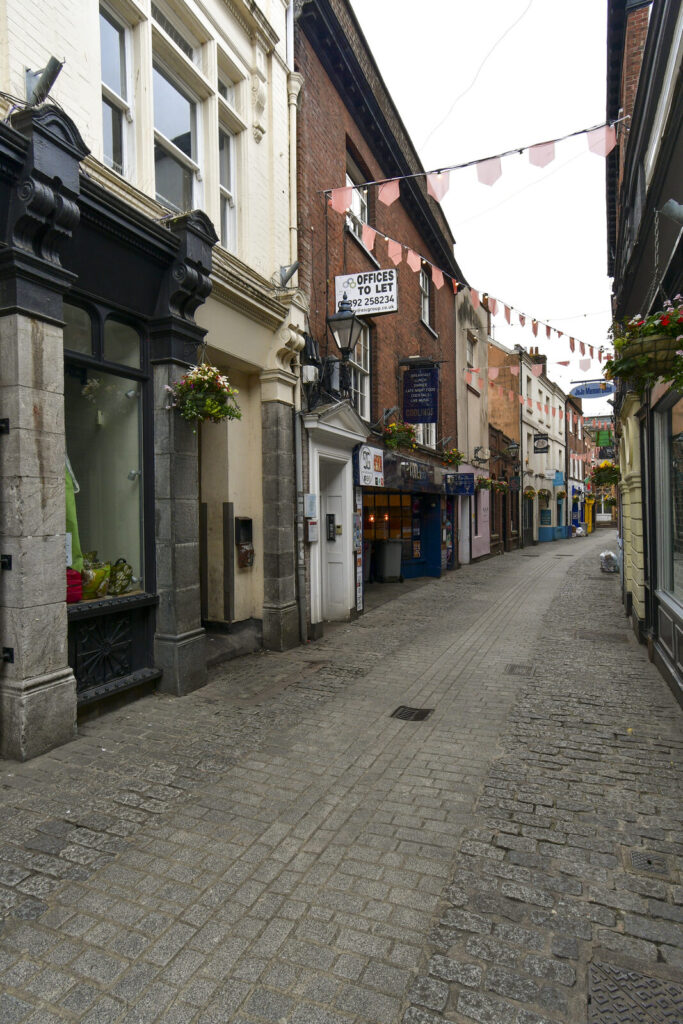
Exeter Asked Permission to Open a Medieval Hall on Gandy Street
EXETER, DEVON, OCT. 26, 2026 · A.L. 6026
The Devonshire Freemasons have applied to open their city-centre headquarters to more than the Brethren who already have a key. Exeter Today reported the application on Oct. 26. Listed-building consent 26/1346/LBC, for 27 Gandy Street, was received by Exeter City Council on Sept. 7 and validated on Oct. 12. The planning record still shows it as pending. Nothing has been approved.
The work they want permission for is practical: put back a level entrance, widen the corridor, add a disabled toilet, and rework the lobbies on the ground and first floors. The application says the aim is to keep the building in Masonic use and widen access for the community, so the listed building has a reason to last.
From the street it is a modest medieval front, Grade II, squeezed between shops. The papers say the frontage hides an amalgamation of buildings of different ages. A stone carving inside records a rebuild in 1895 after a fire. The Devonshire Freemasons have occupied it since 1885. They paid £1,100. It is not open to the public now.
A Devon Live reporter who was shown through in 2018 described the plain approach and then the temple: chairs around a black and white floor, working tools painted on the walls, tracing boards, a rough ashlar and a smooth one, and the Master's chair in the East. That tour is eight years old. It is useful only as a description of the room the application would make easier to reach.
The news this week is a form, not a ribbon. If the council agrees, a stranger will be able to walk into a hall that has been a Lodge since the year the Brethren bought it for a little more than a thousand pounds.
Source: Exeter Today, Oct. 26, 2026
Additional reference: Exeter City Council application 26/1346/LBC
ENGLAND
Tendring, Essex
Essex Put £60,000 Behind Parents on the Tendring Coast
TENDRING, ESSEX, OCT. 20, 2026 · A.L. 6026
Essex Freemasons and the Freemasons' Charity gave Parents 1st UK £60,000 over three years. The province announced it on Oct. 20. The money keeps the charity's work with families in Tendring and adds a peer support worker.
Parents 1st UK has worked with families since 2008. The support is free, through pregnancy, birth and the early months, one to one or in a group. Last year the charity reached more than 1,900 people across Essex. The team is about 30 staff, most of them part time, and 12 volunteers. The Essex programme received the King's Award for Voluntary Service in 2023. Founder Celia Suppiah was made an MBE in 2025 for services to families in pregnancy and early childhood. She stepped down in 2024. Paula Beare is chief executive.
Beare said the three-year commitment will let them stay with parents in Tendring and reach further. Chris Hicks, Provincial Grand Charity Steward, said the need shows up in the other family grants Essex has made in recent months, including EXTRA in Jaywick and Home-Start Essex in Maldon.
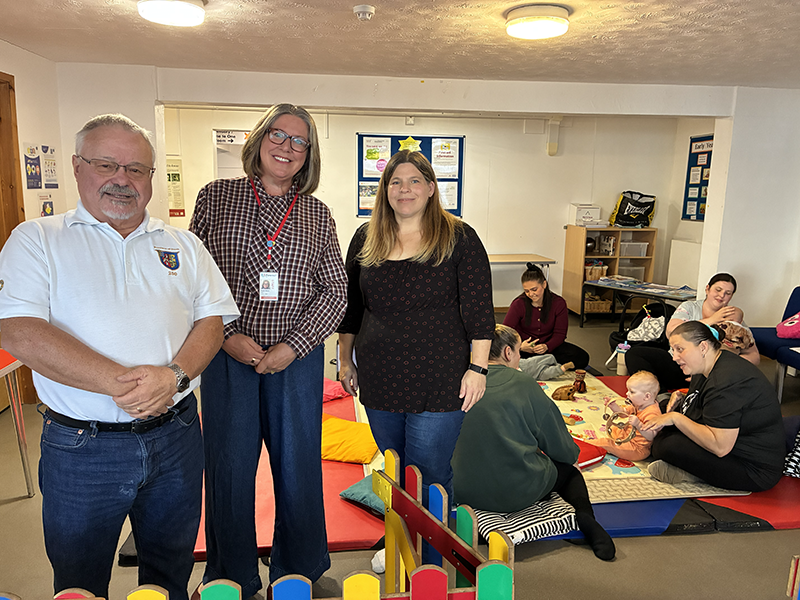
The photograph is a Lullaby Time session in Clacton: Hicks, Beare, and peer support worker Sarah Wood, with parents and babies on the mats behind them. London's cheque last week was for a therapeutic programme that starts before birth. This one is the neighboring kind of work, a person who has already had a baby sitting with someone who is about to.
Source: Essex Freemasons, Oct. 20, 2026
ENGLAND
Chester-le-Street, County Durham

Thirty Durham Riders Brought Back £25,000 for a Pool
CHESTER-LE-STREET, COUNTY DURHAM, OCT. 20, 2026 · A.L. 6026
Durham Freemasons handed Heel and Toe Children's Therapy Centre £25,000 for the running cost of its hydrotherapy pool. The Freemasons' Charity published the gift on Oct. 20.
The money came from the Durham Freemasons Cycling Group and the Coast and Castles ride, held for the province's 2032 Festival. Organisers Gavin Rowell and Steve Piercey went back to the centre near Chester-le-Street to present it. This was the group's ninth charity ride. From Sept. 4 to 6, 30 riders and five drivers covered nearly 200 miles from Pelton to Portobello in Edinburgh.
Heel and Toe works with children who have physical disabilities and complex needs. It takes no government funding and has to raise about £900,000 a year. Natalie Duncan, the fundraising manager, said a gift this size from one event is unusual. The pool costs the charity about £5,000 a month. Rowell said the three days of wind and rain made more sense after he watched children in the water.
The province's 2032 Festival is due to launch in January 2027, with a target above £3 million over five years. The photograph is simpler than the target. Two riders in Durham shirts hold a blue jersey printed with £25,000. The pool is the part a Brother cannot see from the path.
SCOTLAND
Tarbert, Isle of Harris
Harris Took £4,000 for a Hall the Pipe Band Already Uses
TARBERT, ISLE OF HARRIS, OCT. 12, 2026 · A.L. 6026
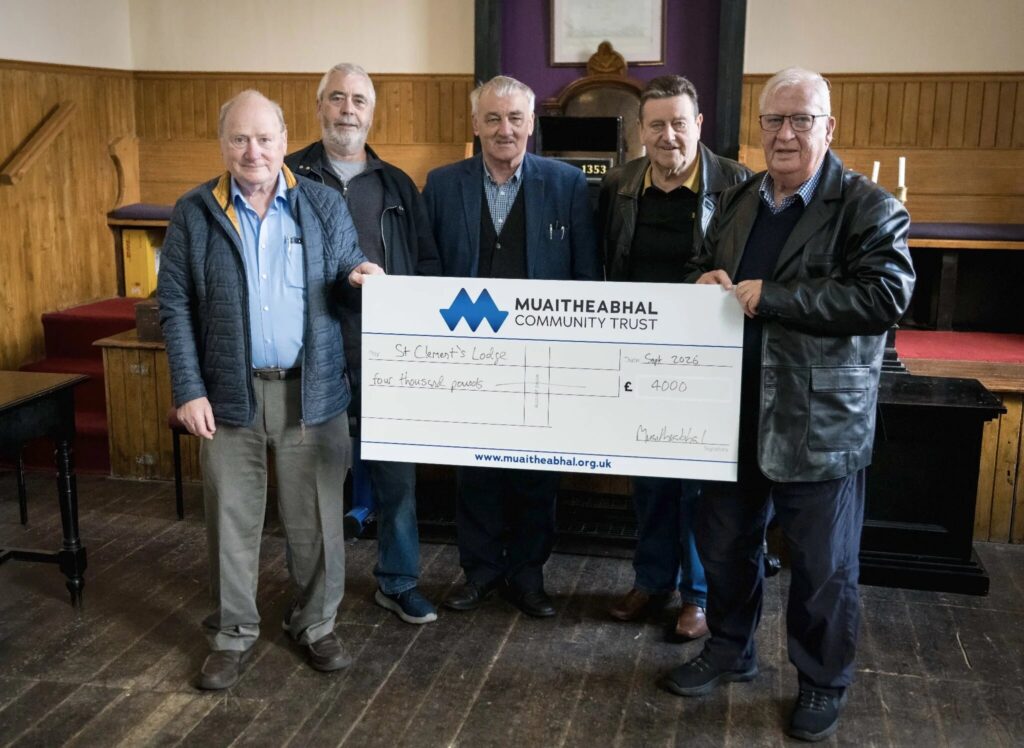
Muaitheabhal Community Trust awarded Lodge St Clement's £4,000 toward a centenary refurbishment of its hall in Tarbert, Isle of Harris. The trust published the grant on Oct. 12. The ceremonial cheque in the Lodge photograph is dated September 2026.
The job is expected to cost about £8,000. Lodge members will give time alongside the trades. The hall has never had a full renovation. It is still used. The trust's reason for the cheque was not the centenary by itself. Donnie Morrison, a board member, said St Clement's is a community room: the pipe band and local dancers use it without paying, and so do other meetings. Henry William MacInnes, speaking for the Lodge, said the same thing from the other side of the cheque. The people who use the building every week have never paid a penny to do it.
The Provincial Grand Lodge of Inverness-shire lists the Lodge as St Clement's No. 1353, and the number is on the wall behind the men in the photograph. The province's calendar had a centenary celebration on Harris in August. The October news is the smaller, more useful sentence: half the money for a hall that already earns its keep by staying unlocked for the island.
A centenary jewel is easy to announce. A pipe band that does not have to hire a room is the part worth telling a Lodge about.
Source: Muaitheabhal Community Trust, Oct. 12, 2026
Additional reference: Hebrides News
 UNITED STATES
New Haven, Connecticut
New Haven Set a Gala for a Temple Whose Stone Was Laid in 1926
NEW HAVEN, CONNECTICUT, OCT. 24, 2026 · A.L. 6026
Hiram Lodge No. 1 spent this month on the centenary of the temple at 285 Whitney Avenue. The Lodge's own invitation set a Grand Lodge rededication and open house for Oct. 3, and a centennial gala for Oct. 24 at 6 p.m. Tickets were $55, with a drink ticket included. A Centennial Club gift of $100 put a name on a plaque and came with a coin and a tie. Worshipful Master Clinton Potter's October note put the open house from 8 a.m. to 2 p.m., with the rededication at 10.
The Trestleboard has the invitation and the Worshipful Master's calendar. It does not have a report from the banquet hall, so this is the schedule and the building, not a claim about who sat where on Saturday night.
The stone under the anniversary is older and better documented. On June 12, 1926, Grand Master Arthur N. Nash and a line of Grand Lodge officers, including Past Grand Masters, the Grand Architect and the Grand Bible Bearer, went from a special communication at Hiram's rooms on Crown Street to the Whitney Avenue site and laid the cornerstone. New Haven Mayor James B. Tower, then Senior Warden of Hiram No. 1, spoke. Artifacts were placed in the stone. The Grand Lodge closed back on Crown Street and went to dinner at the Hotel Taft. The Magpie Mason retold that day on Sept. 29, ahead of this month's events.
Hiram No. 1 says it was chartered in 1750 and is the oldest Lodge in Connecticut. The Lodge has called 285 Whitney Avenue the largest and last remaining grand purpose-built Masonic temple in the state. A building that has kept the same owner for a hundred years is the rare part. The gala was the excuse to say so in public.
Source: Hiram Lodge No. 1
Additional reference: The Magpie Mason, Sept. 29, 2026
Have a Masonic Story?
Know about a Lodge with a story worth telling? A historic building, unusual degree, forgotten artifact, traveling Brother, restoration project, anniversary, discovery, or piece of Masonic history that deserves a wider audience?
The Trestleboard wants to hear about it.
Submit stories, tips, photographs, or article ideas to:
newsletter@travelingashlar.com
This week's stories share an interesting thread.
A museum sign, a planning notice, and three cheques do not look like the same work. They are. One man spent ten years collecting paper so a city that had banned the Craft could read it in daylight. A Lodge in Devon is asking permission to let the public through a medieval door. The rest of the money is smaller and closer to the ground: a pool, a peer supporter, a hall on an island.
The Craft survives through buildings, ritual and records, certainly.
It also survives when somebody puts a sign on a street a stranger can find.
Have a Masonic story? Historic Lodge buildings. Unusual traditions. Old photographs. Brothers doing remarkable things. Masonic objects with a story behind them. News from your Lodge, District, Grand Lodge or Masonic travels. Send it to newsletter@travelingashlar.com.
The Trestleboard is published weekly by Traveling Ashlar.
Wear. Share. Travel.
Wear. Share. Travel.
blog.travelingashlar.com
Wear. Share. Travel.
Top selling items
Pins, shirts, and gifts Brothers actually buy. No membership required.

Masonic Baseball Lapel Pin | Freemason Baseball Gift
Price range: $9.99 through $18.95

Green Beans Lapel Pin | Funny Freemason Gift
Price range: $9.99 through $18.95

Hot Sands Comic Book | Masonic Ritual Gift
$12.99
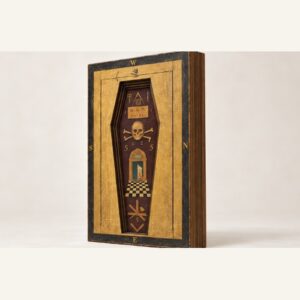
Masonic Tracing Board | 5-Layer Wooden Masonic Art
From $19.99
Subscribe to the Weekly Trestleboard
Get the latest Masonic news from across the world, and the travels that go with it.
One edition every Monday. Stories from lodges, roads, and Brothers still at the work.
Past issues
Every Monday edition, kept on the shelf.
- Edition 0010 Week of October 26, 2026 · A.L. 6026
- Edition 0009 Week of October 19, 2026 · A.L. 6026
- Edition 0008 Week of October 12, 2026 · A.L. 6026
- Edition 0007 Week of October 5, 2026 · A.L. 6026
- Edition 0006 Week of September 28, 2026 · A.L. 6026
- Edition 0005 Week of September 21, 2026 · A.L. 6026
- Edition 0004 Week of September 14, 2026 · A.L. 6026
- Edition 0003 Week of September 7, 2026 · A.L. 6026
- Edition 0002 Week of August 24, 2026 · A.L. 6026
- Edition 0001 Week of August 17, 2026 · A.L. 6026
Posts
Published Traveling Ashlar posts on Facebook. Tap a post to open it there, then share it to your own page or profile.


